Sudden Sensorineural Hearing Loss
Leave a commentNovember 2, 2026 by The Citron Review
by Giuseppina Iacono Lobo
Giuseppina Iacono Lobo is a former academic turned English teacher and crochet artist. She lives in southern Connecticut with her husband, three children, and rambunctious pup. Giuseppina has published several pieces about her experiences living with Charcot-Marie-Tooth disorder, an inherited neuromuscular disorder, and navigating the world as a disabled person. When not teaching or writing, Giuseppina enjoys cooking, crocheting amigurumi, reading, and spending time with her family.
For the accessibility of screen readers, see the text below for “Sudden Sensorineural Hearing Loss,” by Giuseppina Iacono Lobo.
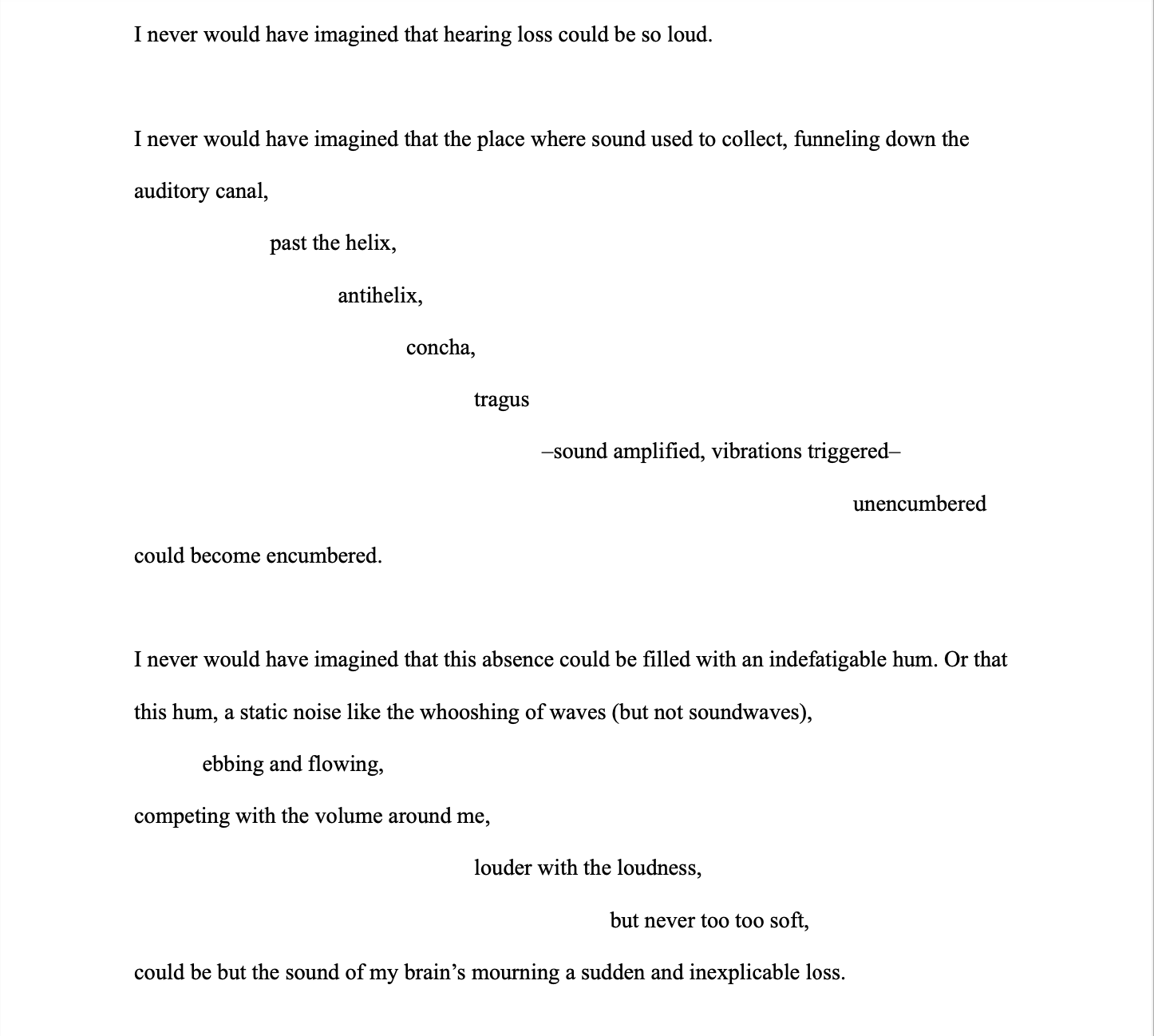
I never would have imagined that hearing loss could be so loud.
I never would have imagined that the place where sound used to collect, funneling down the
auditory canal,
past the helix,
antihelix,
concha,
tragus
–sound amplified, vibrations triggered–
unencumbered
could become encumbered.
I never would have imagined that this absence could be filled with an indefatigable hum. Or that
this hum, a static noise like the whooshing of waves (but not soundwaves),
ebbing and flowing,
competing with the volume around me,
louder with the loudness,
but never too too soft,
could be but the sound of my brain’s mourning a sudden and inexplicable loss.
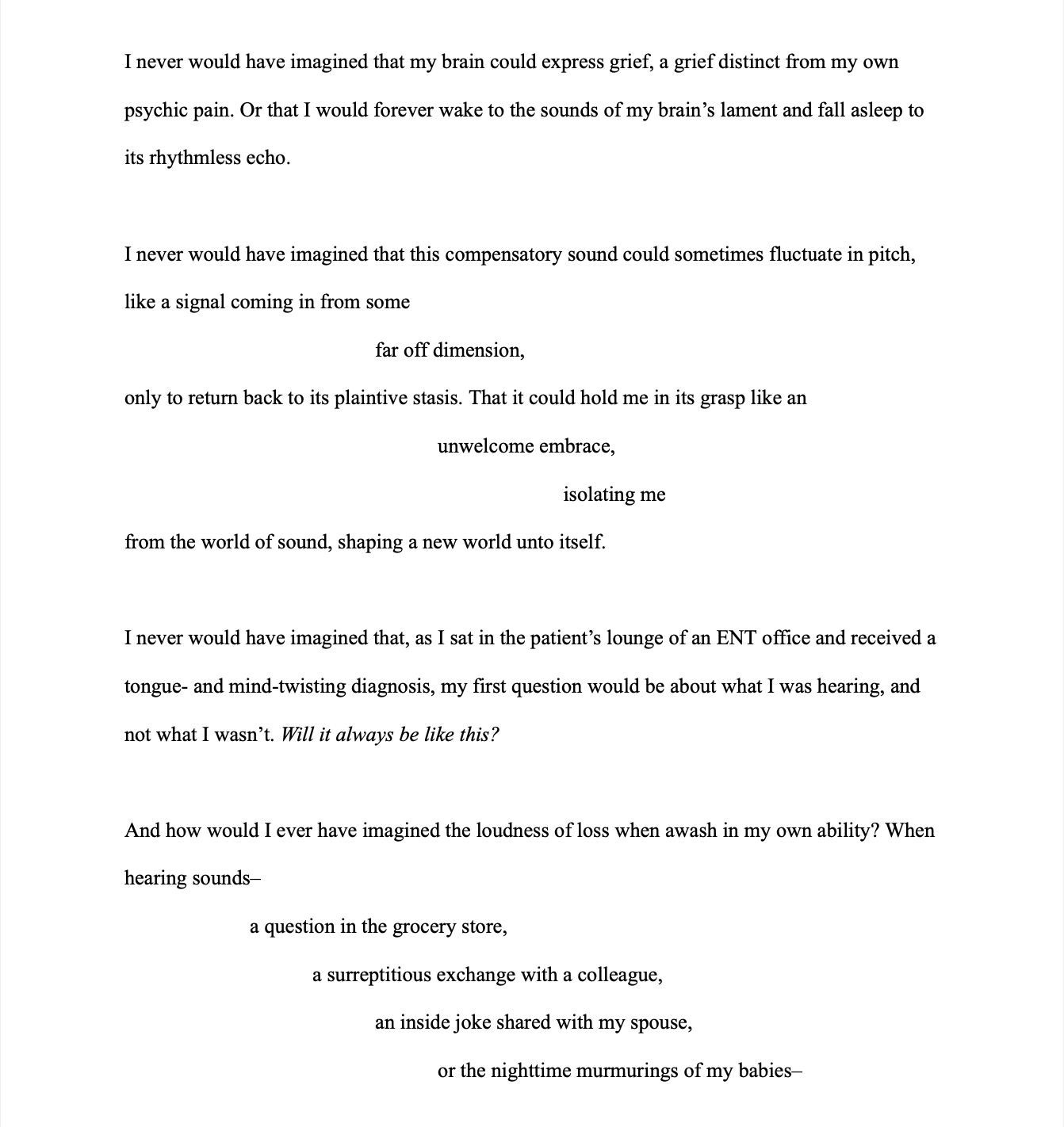
I never would have imagined that my brain could express grief, a grief distinct from my own
psychic pain. Or that I would forever wake to the sounds of my brain’s lament and fall asleep to
its rhythmless echo.
I never would have imagined that this compensatory sound could sometimes fluctuate in pitch,
like a signal coming in from some
far off dimension,
only to return back to its plaintive stasis. That it could hold me in its grasp like an
unwelcome embrace,
isolating me
from the world of sound, shaping a new world unto itself.
I never would have imagined that, as I sat in the patient’s lounge of an ENT office and received a
tongue- and mind-twisting diagnosis, my first question would be about what I was hearing, and
not what I wasn’t. Will it always be like this?
And how would I ever have imagined the loudness of loss when awash in my own ability? When
hearing sounds–
a question in the grocery store,
a surreptitious exchange with a colleague,
an inside joke shared with my spouse,
or the nighttime murmurings of my babies–
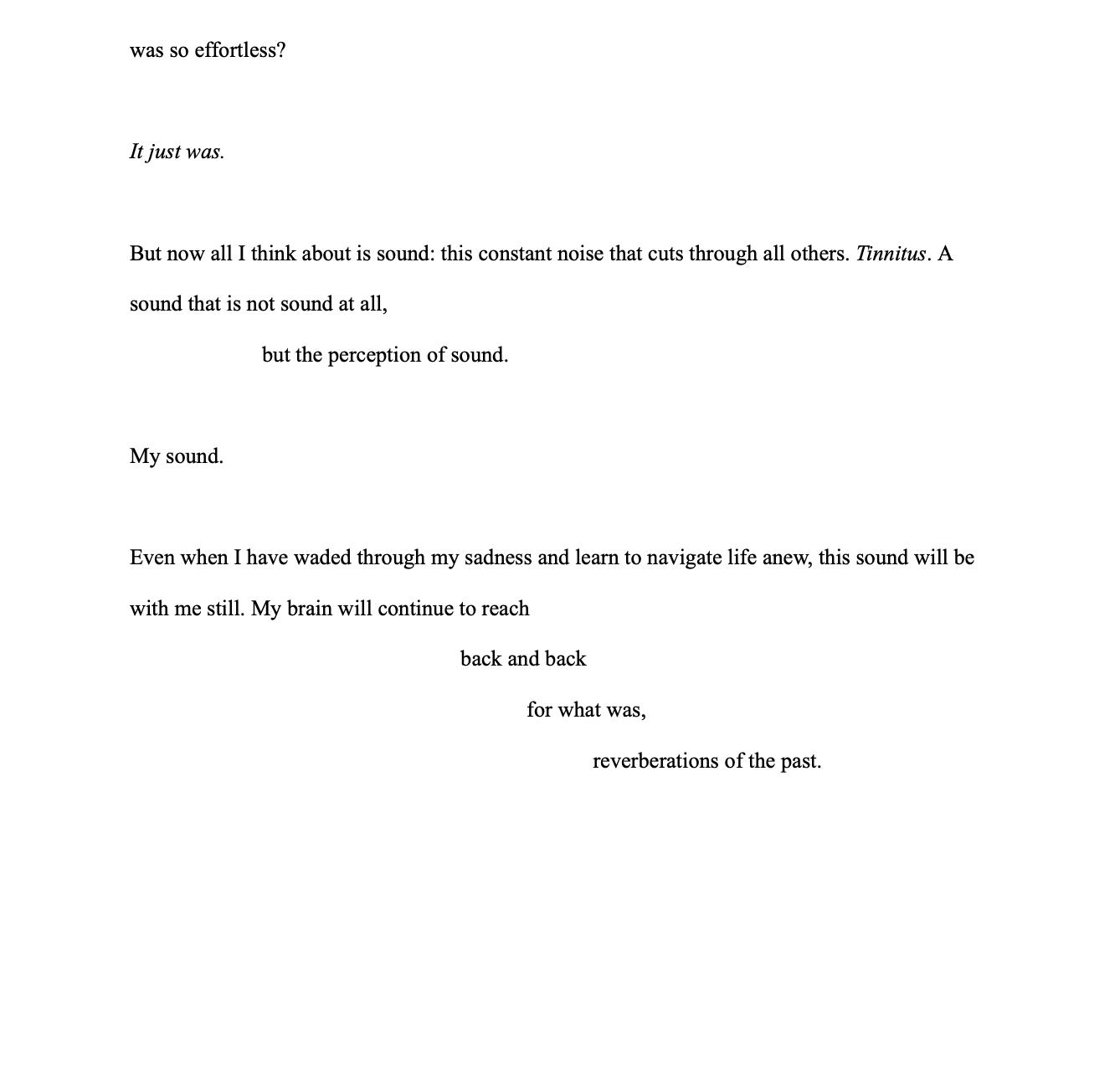
was so effortless?
It just was.
But now all I think about is sound: this constant noise that cuts through all others. Tinnitus. A
sound that is not sound at all,
but the perception of sound.
My sound.
Even when I have waded through my sadness and learn to navigate life anew, this sound will be
with me still. My brain will continue to reach
back and back
for what was,
reverberations of the past.


